
Ashot Nanayan
CEO and Founder
Faceless Digital Marketing: 2026 Guide for Beginners
A few years ago, no one would have imagined that it would be possible to promote your brand, get millions of views, subscribers, and followers without even showing your face.
No one would have imagined that the shyest kid in the class could earn thousands of dollars just with an iPhone or a camera, and I believe this is crazy.
In this guide, I’m going to cover everything about faceless digital marketing, from what it is, the formats and platforms you should use, to examples, practical strategies, and more. I hope you’ll love it. Enjoy the ride.
What is Faceless Digital Marketing?
Faceless digital marketing is a way of promoting a brand, product, service, or content online without putting a real person’s face at the center of the marketing.
In simple words, it means you are still doing digital marketing, but you are not building everything around yourself as a public personality.
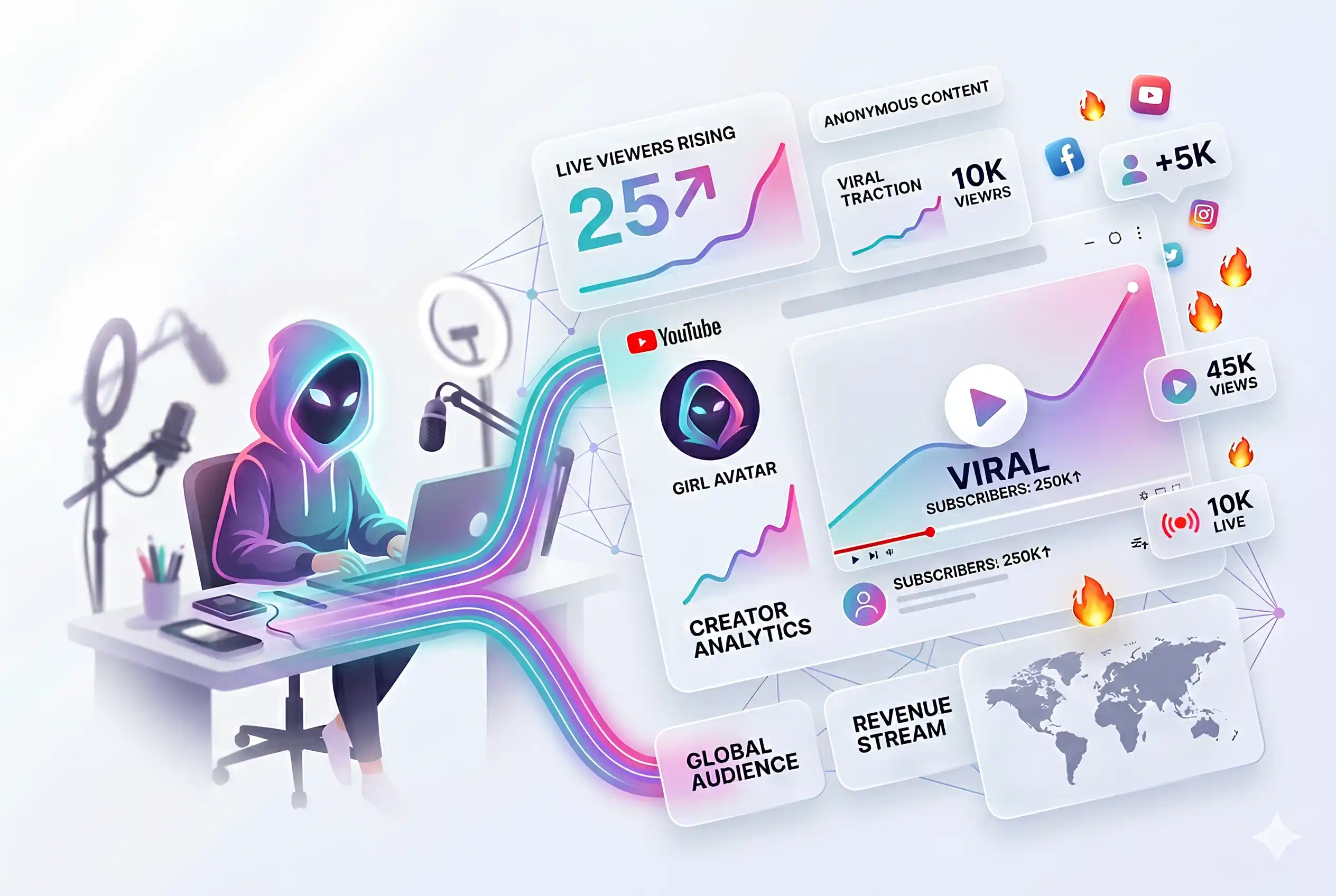
Instead of showing your face on camera, you might use voiceovers, text-based videos, screen recordings, animations, stock footage, product visuals, AI visuals, graphics, memes, blog posts, SEO, email marketing, or social media pages that focus on the brand itself.
For example, a faceless Instagram page can grow by posting quote graphics, carousels, short videos with captions, or niche content without the owner ever appearing.
A faceless YouTube channel can get millions of views using storytelling, tutorials, commentary, or educational content with stock clips, visuals, or narration.
Faceless Digital Marketing Tutorial For Beginners
Faceless Digital Marketing Examples
Faceless digital marketing can appear in many different ways. One common example is a faceless YouTube channel that uses voiceovers, stock footage, screen recordings, or animations instead of putting a person on camera.
Another example is a faceless TikTok account or Instagram page that grows through quote posts, meme content, mini tips, carousel posts, or short videos with text and background visuals only.
It can also look like a niche blog that gets traffic from Google and generates affiliate sales or leads without the audience ever knowing who owns it. The same goes for email newsletters built around useful content, curated insights, or product recommendations without any personal brand attached.
Even brands that rely mostly on SEO, Pinterest, or automated content funnels can fall into this category if the marketing works without a visible face behind it.
Common Faceless Marketing FAQs
Because it is easier to scale, less dependent on one person, and often cheaper to maintain. It also helps brands stay consistent even when team members, creators, or trends change.
It works well for businesses, personal brands that want privacy, affiliate sites, media brands, agencies, and creators who prefer to stay behind the scenes while still building a strong online presence.
They build trust through useful content, consistency, strong branding, proof of results, customer reviews, and clear messaging. People do not always need a face if the value feels real and reliable.
Short videos, tutorials, screen recordings, storytelling clips, opinion-based posts, educational carousels, AI-assisted visuals, and content that solves a very specific problem tend to get the most attention now.
AI helps with content ideas, scripts, voiceovers, visuals, editing, research, and automation. It makes faceless marketing faster and easier, but the strategy and quality still matter more than the tool itself.
Top Faceless Content Formats
Below, I’ve put together some of the most common and popular faceless content formats and compared them side by side, so you can quickly see how they work, where they fit best, and what makes each one different.
This should give you a clearer idea of which format makes the most sense for your goals, your skills, and the kind of content you want to create.
| Content Format | What It Looks Like | Best Use Case |
|---|---|---|
| Short-form videos | Fast clips with text, stock footage, AI voice, or captions | Reach, awareness, viral growth |
| Long-form videos | YouTube-style videos with narration, visuals, and editing | Education, authority, monetization |
| Email newsletters | Regular emails with tips, insights, or updates | Nurture, retention, direct audience access |
| Podcasts without video | Audio-only content with no personal face shown | Storytelling, interviews, niche authority |
| UGC-style faceless clips | Product or service videos filmed without showing a face | Ads, social proof, conversions |
| Animation videos | Motion graphics, explainer videos, or animated scenes | Explainers, storytelling, ads |
| Community posts | Polls, text updates, questions, and opinion posts | Audience interaction, engagement |
Top Platforms for Faceless Marketing
There are plenty of platforms you can use, from YouTube and TikTok to Instagram, blogs, Pinterest, and more. The right one really depends on your goals, the type of content you want to create, how fast you want to grow, and what feels easiest for you to manage consistently.
To make things simpler, below I’ve created an easy-to-read table so you can compare the main platforms, look at the pros and cons, and get a better idea of which one fits you best.
| Platform | Why It Works | Best For |
|---|---|---|
| YouTube | Strong reach, long-term search traffic, and high monetization potential | Education, tutorials, faceless channels |
| TikTok | Fast exposure and strong organic reach for short-form content | Viral growth, trend-based content |
| Great for reels, carousels, and visual brand building | Lifestyle, product, and brand content | |
| Strong for authority, B2B visibility, and professional trust | B2B brands, agencies, consultants | |
| Useful for community building, ads, and broad audience targeting | Groups, local reach, paid promotion | |
| Can drive steady visual search traffic over time | Blog traffic, product discovery, inspiration content | |
| X / Twitter | Good for quick opinions, trends, and niche audience building | Thought leadership, news-style content |
| Email Marketing | Gives direct access to your audience without platform dependence | Retention, nurturing, repeat traffic |
| Helpful for niche visibility and community-based discovery | Research, trust-building, discussion-led traffic |
Top Business Models that Fit Faceless Digital Marketing Best
It’s also important to know whether faceless digital marketing is the right fit for your business, because not every business model works equally well with faceless digital marketing. Some are a much better fit because they do not depend on personal branding, daily face-to-camera content, or building everything around one person.
That is why, before you jump in, it helps to look at which business models make the most sense for this style of marketing. Below, I’ve added a simple table to help you compare some of the best options and see which one may fit your goals, skills, and long-term plan.
| Business Model | Why It Fits Faceless Marketing | Example |
|---|---|---|
| Affiliate marketing | You can grow traffic and earn commissions without showing your identity | Niche blog, YouTube channel, or review site |
| E-commerce | The brand can lead the marketing instead of a personal face | Shopify store, dropshipping brand, product-led store |
| Digital products | Easy to sell through content, funnels, and automation | Templates, courses, ebooks, prompts |
| Agency | The company brand can stay front-facing while the team works behind the scenes | facing while the team works behind the scenes SEO agency, design agency, PPC agency |
| Membership site | Valuable niche content and community can drive subscriptions without a visible founder | Private resource hub, paid newsletter, insider community |
| Ad-based content business | Faceless traffic channels can monetize through display ads or platform payouts | Blog, niche content site, YouTube automation channel |
| SaaS | Product demos, tutorials, and problem-solving content work well without a founder face | AI tool, SEO software, productivity app |
A Practical Faceless Marketing Strategy for Beginners
In recent years, I’ve reviewed and been personally involved in parts of faceless marketing campaigns for different brands, from partnerships with faceless influencers to faceless content strategies on TikTok, YouTube, and Instagram.
I’ve helped with strategy, content direction, and figuring out what makes sense based on the brand, the audience, and the platform.
To be honest, not everything worked from day one. We faced challenges, tested different ideas, failed several times, and learned a lot through the process. That’s usually how it goes.
So, based on my experience, along with what I’ve seen, tested, and learned, below are the practical steps I believe beginners should follow if they want to start faceless digital marketing the right way.
The Strategy at a Glance
Pick One Niche
Start with one niche you understand or genuinely enjoy
Choose One Main Platform
Focus on one main platform first so you can learn
Choose One Main Platform
Diversify with affiliates and sponsors
Create Your First Content System
Build a simple content system you can repeat every week
Improve Based on the Performance
Watch what gets clicks, saves, shares, or views
Pick One Niche
A lot of beginners try to multiply their chances by focusing on several industries or several niches at the same time (E.g., a faceless channel for finance).
In my opinion, that is a big mistake. I believe that whether you’re doing faceless marketing or almost anything else in life, focusing on one thing gives you a much better chance of getting real results.
So first of all, pick one niche.
In this article, I also shared what kinds of niches work well on platforms like YouTube, for example.
When choosing your niche, try to look at a few important things, such as whether you have an interest in it, whether there is real demand and trend potential, and how that niche performs on different platforms.
Some niches work better on YouTube, while others may do better on TikTok, Instagram, or somewhere else.
So take a bit of time, evaluate everything properly, pick one niche, and then move forward.
Choose One Main Platform
Let’s not forget for a moment that, first of all, I’m an SEO expert. So no matter what I’m reviewing, one of the first things I naturally look at is demand. I always want to see where the search volume is, where the attention is, and where the opportunity is.
If I put everything else aside, the number one reason I would choose YouTube is that, compared to TikTok, Instagram, and many other social platforms, YouTube still has a much stronger demand overall. That is why, personally, I would pick YouTube as the main channel first.
However, I also have many friends and people around me who focus mostly on Instagram or TikTok, and for them, it works really well too. So this does not mean YouTube is the only option. It just means that if I had to pick one main platform from the start, YouTube would probably be my first choice.
Build a Clear Content Angle
By “clear content angle,” I mean the specific direction and style of your content. In other words, what are you going to talk about, how are you going to present it, and why should people follow your content instead of thousands of similar pages out there?
The right move here is to be specific. The wrong move is to stay too broad and post random content with no identity.
For example, instead of creating a faceless page about “business,” it is much smarter to focus on something more clear like “short business lessons from famous brands” or “simple startup tips for beginners.”
Create Your First Content System
Next, you should create your first content system. What I mean by that is you need a repeatable way to come up with ideas, create the content, edit it, publish it, and keep the process moving without starting from zero every single time.
This is very important because faceless digital marketing becomes much easier when you have a system (Automation, tools, templates, etc).
You should think about how you will handle topic research, scripting, visuals, editing, posting, and even whether you want to use tools, templates, or AI automation to save time in some parts of the process.
Improve Based on the Performance
Publish faceless content on different platforms at the beginning, and after some time, look at the performance and decide which one or two platforms are worth focusing on more. In my opinion, that is a much better approach than trying to force yourself to stay everywhere for too long.
At the same time, it is very important to understand that every platform has its own standards, audience behavior, and content style.
I would not recommend posting the exact same content everywhere without changes. It is usually much better to adapt your content to each platform, whether that means changing the format, the tone, the structure, or even the way you open the content.
Common Mistakes That Hold Faceless Brands Back
Recently, I was watching interviews with a mix of very famous YouTubers, both faceless creators and more traditional ones, and there were a lot of interesting points that really stood out to me.
Here is one of the videos (Enjoy it)
Why 99% of Faceless Channels Fail
A lot of what they said also connected with things I’ve personally seen in my own journey while working with different companies, including AI brands like CapCut, ZebraCat, and many others.
When I combined those insights with my own experience, a few common mistakes became very clear. So below, I’m going to go through the main ones I believe hold faceless brands back the most, and that beginners should try to avoid from the start.
Copying Other Brands with no Real Angle
One of the biggest mistakes beginners make is copying other brands too closely without bringing any real angle of their own. They see a page doing well, copy the style, copy the format, copy the topics, and then wonder why nothing works for them.
However, if your content feels like a weaker version of something people have already seen a hundred times, there is no strong reason to follow you, remember you, or trust your brand.
People may not always say it directly, but they can feel when a page has no identity.
Please understand, getting inspired is normal. Blind copying is where things go wrong. You need your own angle, your own style, or at least your own way of packaging the idea.
Publishing Too Much Low-Value Content
Another common mistake is pushing out too much content without enough value in it. A lot of beginners think that more content automatically means more growth. In reality, that is not always how it works.
I would rather publish one strong piece of content a week than post large amounts of weak content just to stay active.
Low-value content usually gets ignored, forgotten, or buried very quickly. Over time, it can also hurt the way people see your brand. If everything feels rushed, repetitive, or empty, people stop expecting anything good from you.
Rely too heavily on AI
This is a big one, especially now. A lot of people rely too heavily on AI and end up creating content that feels empty, repetitive, and lifeless. Yes, AI can help with speed, ideas, structure, and even parts of execution. But when it starts doing everything, the content often loses its human side.
Honestly, I think a lot of people are already getting tired of that. They want human content. They want a human connection. They want to feel that there is a brain behind the content, real taste, judgment, personality, and experience.
Don’t get me wrong. Use AI as a support tool if you want, but do not let it replace your thinking.
Chasing Every Platform at Once
As I already said, this is a big mistake. I really do not like seeing people trying to publish the same videos, the same content, and the same style everywhere at once, hoping that something will work just because they are active on many platforms.
From my side, and honestly not just from my side, this approach is usually not that great. Every platform works differently. So when you try to be everywhere from the beginning, you often end up doing nothing really well.
In most cases, it is much better to focus on one platform, learn it properly, create content that fits it, and do a great job there first. After that, you can expand. But trying to chase every platform at once is one of the fastest ways to lose focus and burn out.
Confusing Faceless with Personality-Free
Some people think that faceless means the content has to feel cold, empty, or robotic. No, dear!
Faceless does not mean personality-free. It just means your face is not the center of the brand. Your content can still have a clear tone, a strong style, a point of view, humor, emotion, and a real identity.
For example, a faceless YouTube channel about business can still feel sharp, opinionated, and memorable even if the creator never appears on camera.
The same goes for a faceless Instagram page that has a very clear voice and style in every post. People may not know your face, but they should still feel that there is a brand or mind behind the content.
The Future of Faceless Digital Marketing
I do not know how others see it, but personally, I believe faceless digital marketing is going to become much bigger with every passing year. If we look three to five years ahead, I would not be surprised if demand becomes 10 to 30 times higher than it is today.
I also do not think this will stay mostly a YouTube thing. Yes, YouTube is already huge for faceless content, but I believe other platforms will push this trend even further, especially TikTok. The way people consume content is changing fast, and not everyone wants to build a brand by showing their face all the time.
A huge number of people, especially younger ones, want the opportunity to create, grow, and earn online, but they do not feel comfortable being on camera.
Some are shy, some care about privacy, and some just do not want their personal identity tied to everything they build. Faceless digital marketing gives them a very real chance to still win online, and that is why I believe this space is only getting started.
Is Faceless Marketing Good for Beginners?
Yes, I think it is a very good option for beginners. In many cases, it is even easier for beginners because they do not need to worry about being on camera, building confidence in public, or turning themselves into the brand from day one.
They can focus more on the strategy, the content, the niche, and the platform. Of course, it still takes work, but for many people, faceless marketing feels much more realistic and less stressful at the beginning.
Does Faceless Marketing Work for B2B Brands?
Yes, absolutely. I think a lot of B2B brands can do very well with faceless marketing if the content is useful and well-positioned.
Many of them can grow through educational content, niche insights, industry pages, SEO, email, LinkedIn content, case-study style posts, or branded videos without putting one person at the center of everything.
Can Faceless Brands Appear in AI Search Results?
Yes, believe me (I’m saying this as an SEO expert). I personally believe this is one of the biggest opportunities right now.
A faceless brand can absolutely appear in ChatGPT, AI Overviews, Perplexity, Gemini, and similar platforms if it builds enough authority, publishes useful content, gets mentioned in the right places, and becomes part of the overall conversation in its niche.
Do I Need AI Tools to Run a Faceless Brand?
IMO, it would be great. They can help, of course. They can save time, help with ideas, speed up editing, scripting, voiceovers, visuals, and other parts of the process.
How do Faceless Brands Make Money?
There are many ways. Some make money through faceless affiliate marketing, some through brand deals, some through ad revenue, some by selling digital products, some by generating leads, and others by selling physical products or services.
It depends on the business model behind the brand. The faceless part is just the style of marketing.
Should I Build a Personal Brand or a Faceless Brand?
That depends on who you are, what you want, and how you want to grow. If you enjoy being visible, speaking publicly, and building around your own identity, then a personal brand may be the better move.
But if you care more about privacy, scalability, or building something that does not fully depend on you as a public figure, then a faceless brand may make more sense.
How Long Does It Take to Grow a Faceless Brand?
There is no perfect answer because it depends on the niche, the platform, the quality of the content, and how consistent you are. In my opinion, the biggest mistake is expecting huge growth too early.
Can a Faceless Brand Feel Premium?
Yes, 100%. A faceless brand can feel very premium if the overall execution is strong. Many faceless brands look far more premium than personal brands just because they have better design, better messaging, better positioning, and a much clearer identity.
Written by
Ashot NanayanCEO and Founder
Ashot Nanayan is the founder of Faceless.blog, and an SEO strategist with a strong passion for digital marketing, faceless content, YouTube growth, and AI-driven content systems. Through hands-on experiments, client exposure, and years of work across digital growth channels, he shares practical ideas on building and growing faceless brands across platforms like YouTube, TikTok, and Instagram.
View Profile